title, topic, keyword
Small group, whiteboard, etc
Required in-class time for activities
Leave blank to search both

Activities

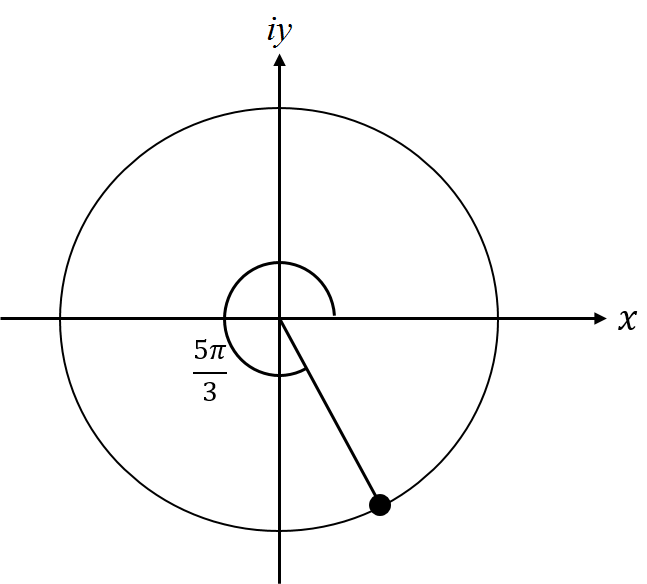
Find the rectangular coordinates of the point where the angle \(\frac{5\pi}{3}\) meets the unit circle. If this were a point in the complex plane, what would be the rectangular and exponential forms of the complex number? (See figure.)

Students move their left arm in a circle to trace out the complex plane (Argand diagram). They then explore the rectangular and exponential representations of complex numbers by using their left arm to show given complex numbers on the complex plane. Finally they enact multiplication of complex numbers in exponential form and complex conjugation.

Problem

5 min.

Phase in Quantum States

In quantum mechanics, it turns out that the overall phase for a state does not have any physical significance. Therefore, you will need to become quick at rearranging the phase of various states. For each of the vectors listed below, rewrite the vector as an overall complex phase times a new vector whose first component is real and positive. \[\left|D\right\rangle\doteq \begin{pmatrix} 7e^{i\frac{\pi}{6}}\\ 3e^{i\frac{\pi}{2}}\\ -1\\ \end{pmatrix}\\ \left|E\right\rangle\doteq \begin{pmatrix} i\\ 4\\ \end{pmatrix}\\ \left|F\right\rangle\doteq \begin{pmatrix} 2+2i\\ 3-4i\\ \end{pmatrix} \]

None
  • Found in: Static Fields course(s)

For an infinitesimally thin cylindrical shell of radius \(b\) with uniform surface charge density \(\sigma\), the electric field is zero for \(s<b\) and \(\vec{E}= \frac{\sigma b}{\epsilon_0 s}\, \hat s\) for \(s > b\). Use the differential form of Gauss' Law to find the charge density everywhere in space.

  • Found in: Static Fields, AIMS Maxwell, Problem-Solving course(s)

Small Group Activity

10 min.

Modeling Nonuniform Density
  • how to distinguish the two different uses of the word “linear” in a linear charge density that varies linearly;
  • some of the words for describing functional variation: linear, quadratic, exponential, falls off like ..., proportional to the square, etc.
  • how to “name the thing you don't know” with an algebraic symbol so that it can appear in an equation.
  • Found in: AIMS Maxwell, Static Fields, Surfaces/Bridge Workshop, Problem-Solving course(s)
  • to perform a magnetic vector potential calculation using the superposition principle;
  • to decide which form of the superposition principle to use, depending on the dimensions of the current density;
  • how to find current from total charge \(Q\), period \(T\), and the geometry of the problem, radius \(R\);
  • to write the distance formula \(\vec{r}-\vec{r'}\) in both the numerator and denominator of the superposition principle in an appropriate mix of cylindrical coordinates and rectangular basis vectors;

Small Group Activity

30 min.

Working with Representations on the Ring
  • How to form a state as a column vector in matrix representation.
  • How to do probability calculations on all three representations used for quantum systems in PH426.
  • How to find probabilities for and the resultant state after measuring degenerate eigenvalues.

Small Group Activity

30 min.

Energy radiated from one oscillator
This lecture is one step in motivating the form of the Planck distribution.
Students calculate two different (thermodynamic) partial derivatives of the form \(\left(\frac{\partial A}{\partial B}\right)_C\) from information given on the same contour map.
  • Found in: Surfaces/Bridge Workshop, None course(s)